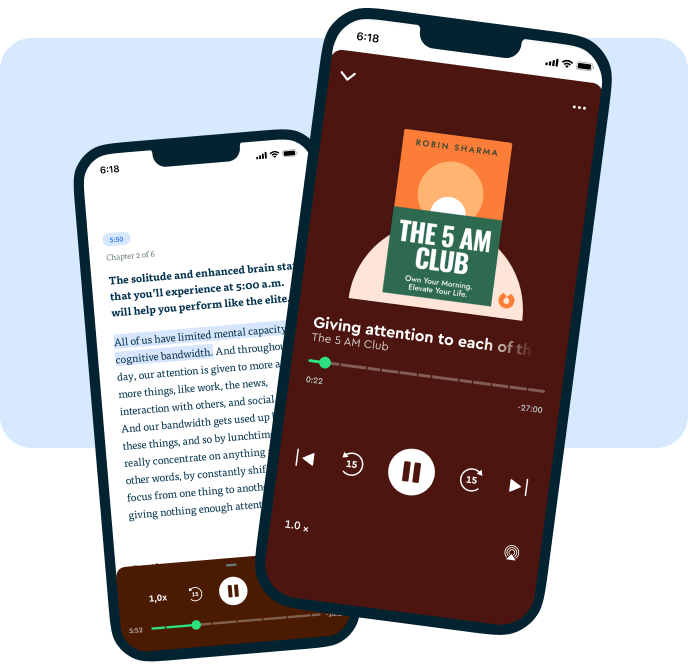
Blinkist is a Berlin-based technology company that creates short, consumable summaries (“blinks”) of nonfiction books and podcasts to help time‑pressed users learn key ideas in about 15 minutes[1][3]. Blinkist’s product is a mobile and web app offering text and audio summaries across many nonfiction categories, aimed at professionals and lifelong learners who want fast, actionable takeaways rather than full-length reads[1][2][3].
High‑Level Overview
- Mission: Blinkist’s stated purpose is to make knowledge more accessible for busy people by distilling nonfiction content into concise, actionable summaries[2][3].
- Product / Who it serves: Blinkist builds an app that delivers 15‑minute written and audio summaries of bestselling nonfiction books and selected podcasts for professionals, students, and lifelong learners seeking efficient learning[1][3].
- Problem solved: It addresses limited time and information overload by extracting core ideas and practical takeaways so users can learn quickly without reading entire books[2][3].
- Growth momentum: Founded in 2012, Blinkist has grown into a paid subscription app with thousands of titles and international reach and employs between about 100–250 people, reflecting steady product and user‑base expansion since launch[1][3].
Origin Story
- Founding & founders: Blinkist was founded in 2012 in Berlin by Holger Seim, Niklas Jansen, Sebastian Klein, and Tobias Balling[1].
- How the idea emerged: The founders created Blinkist to capture and deliver key insights from nonfiction books in a format suited to busy modern lifestyles—short reads and listens that fit into commutes and spare minutes[1][2].
- Early traction / pivotal moments: Early seed and follow‑on funding rounds (including a 2016 Series A with investors such as Greycroft and Headline) supported scaling the content library and user acquisition, helping Blinkist expand its catalog and international user base[1].
Core Differentiators
- Product differentiators: Concise, consistently formatted “blinks” that focus on actionable insights rather than exhaustive summaries set Blinkist apart from longer-form book content and free user‑generated summaries[3].
- Content breadth & format: Offers both text and narrated audio summaries and covers many nonfiction categories, plus a wishlist mechanism for users to suggest titles[3].
- Time‑to‑value: Designed for ~15‑minute consumption, optimizing learning for users with limited time[3].
- Curation & quality process: Blinkist uses editorial teams and freelancers to select, read, and distill books into high‑quality summaries, emphasizing clarity and practical takeaways[3].
Role in the Broader Tech Landscape
- Trend alignment: Blinkist rides the microlearning and on‑demand knowledge trend driven by mobile-first consumption, audio adoption, and desire for efficient lifelong learning[2][3].
- Timing and market forces: Increasing time scarcity, podcast and audiobook growth, and subscription app acceptance create favorable conditions for Blinkist’s value proposition[2][3].
- Ecosystem influence: By curating and spotlighting top nonfiction ideas, Blinkist can shape discovery and author exposure while competing with other summary services, audio platforms, and education/microlearning startups[2][3].
Quick Take & Future Outlook
- What’s next: Continued expansion likely focuses on growing the content library (more books and podcast “blinks”), localization for additional markets, improving personalization and recommendations, and deeper integrations with learning or productivity tools[2][3].
- Shaping trends: Blinkist may push microlearning standards for concise content delivery and influence how professionals consume ideas by reinforcing short‑format learning as a mainstream behavior[2][3].
- Risks and opportunities: Opportunities include partnerships with publishers and enterprises and expanded audio offerings; risks include questions about depth versus brevity, competition from other learning platforms, and licensing or author relations[2][3].
Quick take: Blinkist converts long‑form nonfiction into high‑velocity learning moments that fit modern routines, and its future hinges on balancing scale and curation while evolving features that deepen learning beyond single‑blink consumption[1][2][3].